
You have come for vacation and just deplaned, feeling refreshed, but suddenly you realize the need for cash. The airport are equipped with currency exchange counters, where you can get some money. But this can be the costliest mistake of your life; yes, exchanging currency from the counters or kiosks at the airport currency exchange can be painfully expensive. However, if you are in an urgent need of money, you can still save your money by following these safety and cost-saving strategies and get the money from the airport.
Why do people trust airport cash exchange counters?
Airport exchanges also capitalize on time pressure. When you’re facing a departure in two hours, you’re not in the mindset to compare rates or seek alternatives. The psychological stress of potentially missing your flight makes any solution feel worthwhile, regardless of cost.
Airport exchanges focus on how much time the passenger has to exchange the currency. For instance, you next flight is after 2 hours and you cannot think of anything else than using exchnage kiosk. Despite having so many cons while exchanging the money at the airports, the majority of the travelers tend to see it as a safe option. The reason behind it is the psychological comfort it offers to the passengers who are desperately looking for local cash at that time.
Then we have the convenience factor as well, which cannot be understated because after clearing the security and navigating to your gate, the airport currency exchange kiosk seems like a one-stop solution.
What should you look out for when exchanging money at the airport?
Always check the exchange rates or interbank exchange rates before you go to a counter, say Google, XE, or Wise.
This will give you an idea of how much they’re padding their price.
- Compare Multiple Counters: If there is more than one airport currency exchange center, compare the rates they offer. Don’t just go to the first airport currency exchange you see.
- Swap the minimum amount: Only swap what you need for immediate and essential needs (e.g., taxi, public transport, quick meal). For big exchanges, use cheaper ways to get to your destination or home.
- Ask for total costs: Ask what the total is in local currency, which you will get after any commissions and airport currency exchange fee deductions.
- Be aware of signs that say “0 commission” because the broker is probably making money on a higher exchange rate.
- Instead, use an ATM: If you can find an ATM, you may get a better rate than at a counter for your airport cash exchange. Always choose to be charged in the local currency at an ATM to avoid Dynamic Currency Conversion (DCC) fees.
How to safely exchange money at the airport?
When you need to perform an airport exchange currency at the airport, it is usually the most expensive choice, but if you have no other option for changing your money, there are ways to make it more affordable
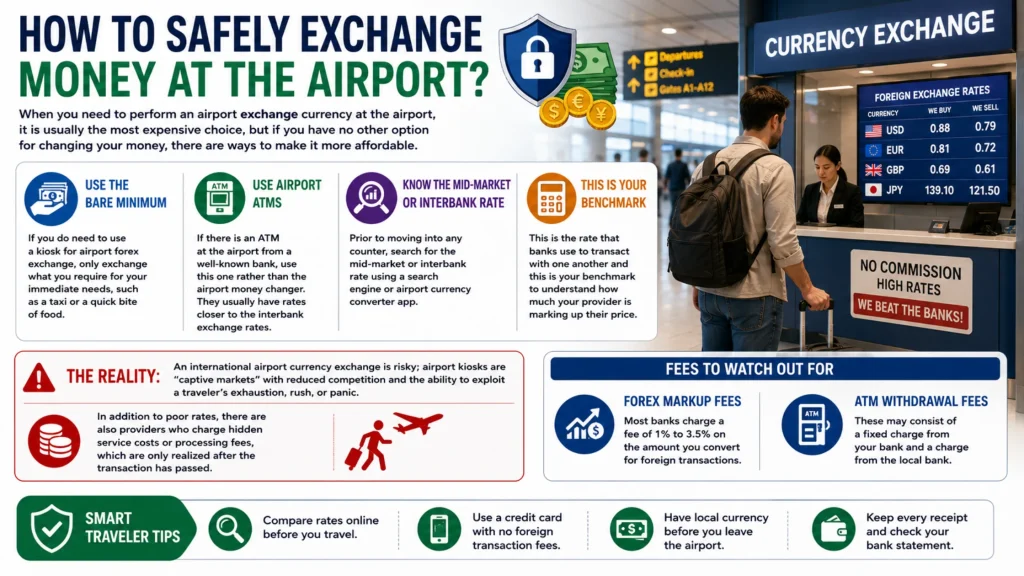
- Use the Bare Minimum: If you do need to use a kiosk for airport forex exchange, only exchange what you require for your immediate needs, such as a taxi or a quick bite of food.
- Use airport ATMs: If there is an ATM at the airport from a well-known bank, use this one rather than the airport money changer. They usually have rates closer to the interbank exchange rates.
- Know the mid-market or interbank rate: Prior to moving into any counter, search for the mid-market or interbank rate using a search engine or airport currency converter app.
- This is the rate that banks use to transact with one another and this is your benchmark to understand how much your provider is marking up their price.
- The Reality: An international airport currency exchange is risky; airport kiosks are “captive markets” with reduced competition and the ability to exploit a traveler’s exhaustion, rush, or panic.
- In addition to poor rates, there are also providers who charge hidden service costs or processing fees, which are only realized after the transaction has passed.
- Forex Markup Fees: Most banks charge a fee of 1% to 3.5% on the amount you convert for foreign transactions.
- ATM Withdrawal Fees: These may consist of a fixed charge from your bank and a charge from the local bank.
Where can you find ATM Exchang points at JFK Airport?
These services can usually be found on the official map/directory of the airport prior to arrival.
At JFK Airport
- Terminal 1 at JFK Airport: There is an airport currency exchange point on Level 3 (after security) and on Level 1 (arrivals).
- Terminal 4 at JFK: On Level 3, Gate B22 and Gate B31 have facilities for currency exchange at airport.
- Terminals 7 & 8: There are several locations for an airport foreign exchange, including the food court area in Terminal 7, the Great Hall, baggage claim, and Concourse C in Terminal 8.
DFW Airport
- Terminal D (International Terminal): There are three main service points for airport cash exchange.
- Gate D24: On Level 2 in the International Departure area, near the American Airlines customer assistance, an exchange counter is located.
- Gate 12: Against the Whataburger, another cash exchange counter is located.
- Arrivals Area: Near the customer exit gate D22 on Level 1, you can find one more counter.
Read Also: – Dallas Airport Currency Exchange and ATM Locations Guide
Tips for how to manage money abroad
If you do not wish to carry a large amount of cash, digital banking of this era provides cheaper and safer alternatives.
- ATMs Abroad: Many travelers feel safe using the ATMs abroad. However, they do not know the negative effect of it. Always aim to withdraw a good amount of cash at once rather than taking out small amounts daily, which will minimize the impact of per-transaction fees.
- International Debit/Credit Card Swipes: If you will be traveling abroad, make sure your bank has a card that is “travel-friendly” and does not charge foreign transaction fees. A card of this type can help you avoid paying a 1-3% fee on each international purchase.
- Dynamic Currency Conversion (DCC) Warning: If you are paying with card and are asked whether you want to pay in your “home currency” or the “local currency,” select the “local currency” option. Selecting your home currency activates Dynamic Currency Conversion, where the store owner’s bank chooses a rate for converting the foreign currency to your local one, and it is frequently a bad one.
How to avoid huge commissions for currency exchange?
Before you make any transaction, use this quick checklist to ensure you are getting a fair deal.
- Obtain the Interbank Rate: When going to any airport money exchange, find out the mid-market rate or the “interbank” rate from a trusted financial site. This is the rate at which banks conduct transactions among themselves.
- Book Forex well before your trip: This way, you get rid of the stress of the airport and keep track of the exchange rates, buying when the rate is right.
- Look for Additional Fees: Be aware of the difference between a commission (often a percentage) and a service fee (a flat fee). Remember to take the time to ask, “What will be the total amount of local money that I would actually get after all fees?”
- Compare Exchange Rates: Do not take the first airport currency exchange rate that you find. By taking the time to look at two or three different providers, you’ll save enough for an extra meal or an excursion on your trip.
Comparison: Forex Exchange Rates & Fees
| Method | Exchange Rate Markup | Additional Transfer/Service Fees | Overall Cost & Value |
| Money Transfer Apps / Digital Platforms | Low to None: There are still many apps that use mid-market exchange rates without any markup, due to which margins apply depending on the app. | Low: Usually charge low or no transfer fees ($0 to $5 for a $300 transfer) They may charge a small flat fee in advance. | Most Cost-Effective: Apps often have lower fees and good rates so more of your money gets to the recipient. |
| Traditional Banks (Sending Money) | Moderate to High: For profit, banks typically add a margin of 1-5% above the interbank rate. | High: Most banks charge high flat fees for wire transfers, often $15 to $50 per transfer. They can also levy charges on currency issuance (Rs 150 to Rs 500). | Expensive: Most banks charge a hefty flat fee for wire transfers, typically between $15 and $50 per transaction. They can also levy service charges for issuance of currency (Rs 150 to Rs 500). |
| Airport ATMs (Withdrawing Cash) | Varies by Card: Most banks charge a hefty flat fee for wire transfers, typically between $15 and $50 per transaction. However, the basic rate is usually a good exchange rate when it comes to kiosks. | Variable: Foreign. ATM fees apply to all transactions and withdrawals. Also, your own card issuer may charge you high fees for foreign currency. | Better than kiosks: Every ATM withdrawal has a fee. Your own card issuer may charge hefty fees for processing foreign currency. |
| Airport Forex Counters (Cash Exchange) | Extremely High: Airports are known to have the highest markups on currency exchange offices, usually 5% to 15%. These rates can be 5 – 7 times better than the local money changers. | Hidden or Flat Fees: They often will advertise “0% commission” but will make up for this by having an exceptionally high markup rate. They can also charge commission on the price. | Most Expensive: Kiosks prey on travelers’ limited options and need for emergency cash. You will have far less local currency. |
What are the other ways to pay abroad?
A normal credit card can cost you an additional 3% on each purchase you make while abroad. Premium travel credit cards waive these fees while offering lucrative travel rewards.
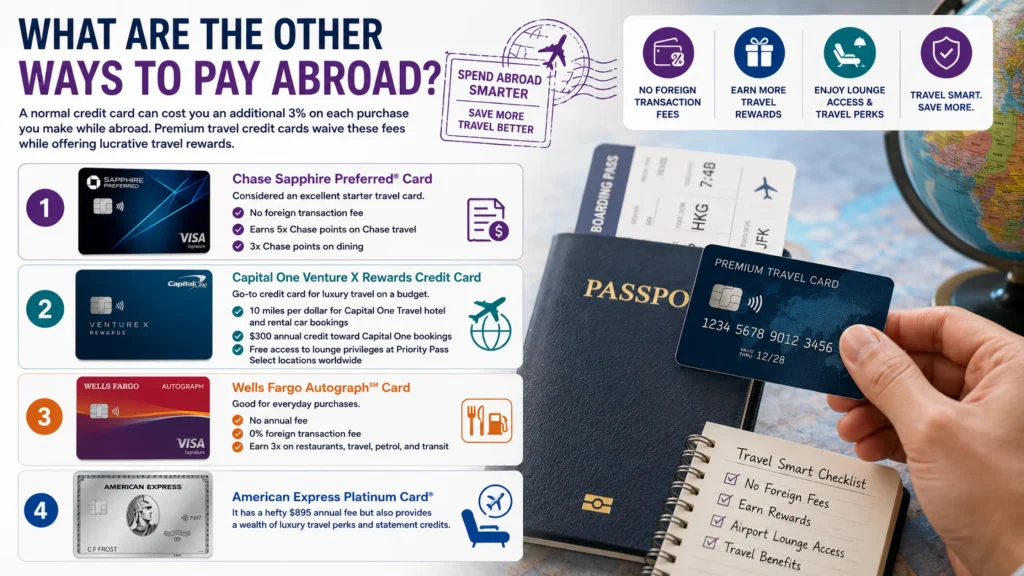
- Chase Sapphire Preferred® Card: Considered an excellent starter travel card. No foreign transaction fee, earns 5x Chase points on Chase travel and 3x Chase points on dining.
- Capital One Venture X Rewards Credit Card: Go-to credit card for luxury travel on a budget, as it offers 10 miles per dollar for Capital One Travel hotel and rental car bookings. It balances the cost of its annual fee with a $300 annual credit toward Capital One bookings. Also free access to lounge privileges at Priority Pass Select locations worldwide.
- Wells Fargo Autograph℠ Card: Good for everyday purchases, no annual fee, 0% foreign transaction fee. Earn 3x on helpful categories such as restaurants, travel, petrol, and transit.
- American Express Platinum Card: American Express Platinum Card® It has a hefty $895 annual fee but also provides a wealth of luxury travel perks and statement credits.
Read Also:- LAX Long Term Parking Rates
Top money transfers and exchange apps
Banks usually charge excessive flat fees and markups to international billers when you need to wire money across borders, pay international bills, or convert cash. Here are some more transparent and affordable options on online platforms.
- Wise (formerly TransferWise) Wise has a real mid-market rate and is a great option for multiple currencies with full transparency. No hidden exchange rate markups. Users pay an explicit percentage fee.
- Revolut: It’s more of a financial management platform, with multi-currency accounts, budgeting tools, and even a real debit card. A great alternative for people who want to organize their international expenses and finances all in one place.
- Xe Money Transfer: An app that acts as a currency converter, an international money transfer service, and a real-time currency exchange converter. It enables the users to keep multiple currencies in balance and convert them on the fly when they are on the winning side of the exchange rates.
- Pesa: It is designed for multi-currency users, and transfers are carried out within minutes. It also supports various wallets for multiple currencies and there are no transfer fees. This is perfect for transacting money across borders.
Conclusion
When traveling from one country to the other, the passenger looks for numerous ways to spend and to save money because the passenger wants to have a lavish vacation with every service provided; however, money can be a factor that can come in between the traveler and spending. On that vacation, the passenger makes sure to carry cash and card but in case the passenger forgets to bring cash, this guide is for them; they can look for currency exchange at the airports and compare the exchange rates, analyze the pros and cons and decide whether to make transfers digitally or use physical cash.
FAQs
No, it is almost never better to change money at the airport. Airport currency exchange desks have a captive audience, so they charge outrageous fees and terrible exchange rates. You could lose from 10% to 15% of your money on markups and service fees.
The worst currency exchange rates are usually at the airport. Airport exchanges sometimes ask for up to 14% more than the current International Monetary Fund (IMF) exchange rate. NerdWallet even found some rates above 17%. Some also add further charges to the poor exchange rate.
You cannot always trust the airport currency exchange.
Use the right credit card
The simplest way to avoid additional charges when traveling. Most cards charge an additional 2.5-3% for foreign currency purchases, but some travel cards waive this fee altogether. Look for a card with “no foreign transaction fees.”
Chase and Starling Bank offer debit cards that can be used abroad without foreign transaction fees. Some Barclays accounts also offer fee free spending abroad depending on the product. Cash withdrawals can be charged, so you need to check with the applicable bank.
Read More: –