
Ever thought of working on a foreign land but still leaving with your friends and family? Do not let the border be a barrier to your growth with a nomad visa. A nomad visa lets you work from any part of the world without actually physically being in that country. To obtain the visa, they require a stable income, proof that they are working remotely and no criminal record.
This guide will cover what a digital nomad visa is, how to apply for a digital nomad visa and the best digital nomad countries in 2026. You’ll also find income requirements, expenses, tax considerations for digital nomads, and more.
What is a digital nomad visa?
This visa allows the workers who are working remotely to legally live in a different country and continue working from there. The visa allows them to reside for a period of 6-24 months, giving them the opportunity to renew the visa if they want to.
Most of the countries are interested in providing the digital nomad visa to those people who are working remotely and getting a salary from a foreign employer or any organization abroad.
Major digital nomad visa requirements will have minimum income thresholds, health insurance, a clean criminal record, and proof of remote work. Some are geared towards employees, others accommodate freelance workers and business owners.
The top countries that come selected for the Digital Nomad Visa are the UAE, Portugal, Spain, and Croatia.
What are the pros of having a digital nomad visa?
Receiving a digital nomad visa gives you the opportunity to work for a long term in another country remotely without the risk of breaking any immigration law.
- A digital nomad visa offers a long-term option to work remotely from another country, with no risk of illegality.
- No change of employment is required, provided it is based outside the country they are in.
- You can enjoy new culture and environment without losing your job and sacrificing your career.
- Also, you will be addressed with a lower cost of living, and you will get the benefits of higher-quality healthcare.
- A few countries that provide digital nomad visas have tax treaties with your country to prevent double taxation. Also, no income tax or exemption from income tax in relation to foreign income may be introduced in digital nomad countries.
- These visas can be the first step towards becoming a permanent resident or citizen of a country. Some countries, such as Portugal, provide straightforward citizenship processes and criteria via the Portugal digital nomad visa.
- Generally, a digital nomad visa is easier to apply for and more easily accepted than a work visa. This is because most of the time, you need a sponsor from a company in the country to which you wish to transfer in order to obtain a work visa.
What are the top 10 digital nomad countries?
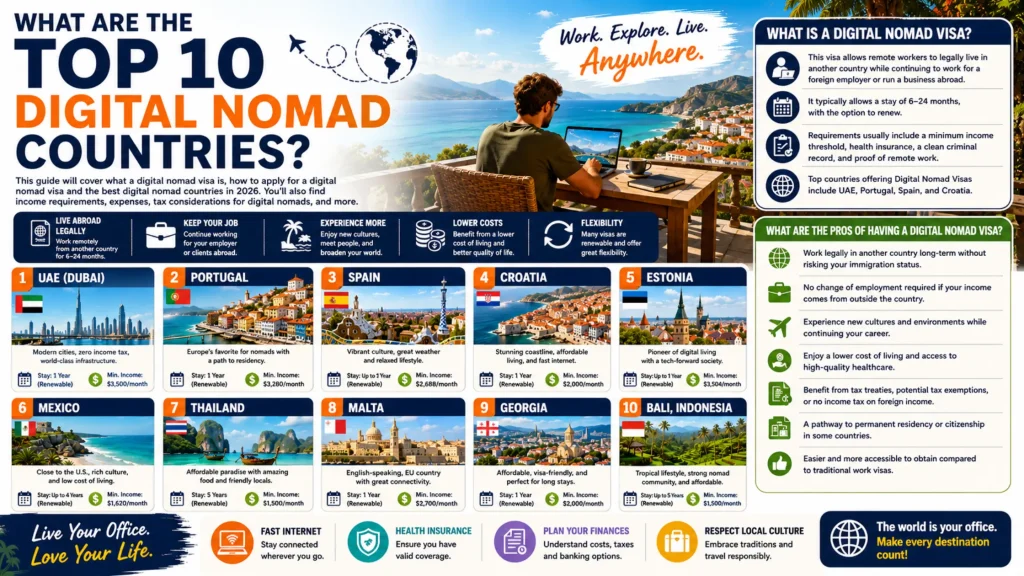
Spain
The Spain Digital Nomad Visa is perfect for remote professionals who are drawn by the Mediterranean climate, walkability, and comprehensive social services. The country offers excellent urban safety, high-quality healthcare (sometimes the top 10 in the world), and good public transport, as well as the fact that it has consistently been rated as one of the best places in the world to live as a digital nomad, according to the Global Digital Nomad Report 2025.
Housing, food, and other living expenses for Spain can often be much cheaper than in other capitals of the Western European Union. Some estimates suggest the cost is as much as 15 to 25% less than in London, Paris, or France. Barcelona and Madrid remain the destinations of choice for tech-savvy wanderers, and Valencia always ranks as one of the top European cities for work-life balance, bike-friendly communities, and quality of life.
Why Americans choose Spain: The Spanish tax law, known as the Beckham Law, allows you to enjoy 100% exemption from tax on foreign-source income. The five-year visa allows you to easily obtain bona fide residence for the purpose of the FEIE.
| Duration of Visa | 12 months |
| Minimum Income Requirement | $2,850 a month for a single adult (check the Spain digital nomad visa requirements). |
| Tax Rules | Foreign Income does not include any tax |
| Renewable | Stay up to 1 year; visa renewal after 5 years |
Portugal
Portugal is also in the top 10 most popular destination countries for remote workers, according to the Global Intelligence Unit’s 2025 Global Digital Nomad Report, taking the 6th position. The Digital Nomad Visa Portugal (D8) provides two types of visas, short-term and long-term, enabling remote workers to establish a foundation in Europe.
Portugal’s high quality of life is attributed to its good public services, its low violent crime rate, and its consistent high quality and accessibility of healthcare across Europe. Many cities, such as Lisbon and Porto, have English as a widely spoken language, simplifying the daily lives of new arrivals.
| Duration of Visa | 1-2 years |
| Minimum Income Requirement | $3,850 monthly (check the Portugal digital nomad visa requirements) |
| Tax Rules | Tax residency, if you stay for more than 183 days |
| Renewable | 1 year, renewable after 5 years |
Tips for Americans: Portugal’s NHR regime provides favorable tax rates. However, you would have to pay some Portuguese taxes, which will be added against the U.S. taxes by a foreign tax credit. For many Americans, FEIE is better than FTC in Portugal.
Croatia
The opinion is that Croatia digital nomad visa is one of the best financially stable options in Europe. It allows the non-EU nationals to stay for up to 12 months without paying any tax on foreign income. One more advantage is that the cost of living is lower by 40-50% compared to Western Europe.
Recently some places have grown into nomad spots, like Split, Zadar, Dubrovnik, and
Zagreb. It makes the living easy for people, because nomad hotspots mean co-living; it has startup events, seasonal festivals, and a remote working community that is known as “Digital Nomad Valley Zadar.”
| Visa Requirement | 12 Months |
| Minimum Income Requirement | $3,170 monthly |
| Tax Rules | Does not require any local tax on foreign income |
| Renewable | Stay for 1 year; this is non-renewable; however, you can apply after a 1-year gap. |
Tip: For all the American citizens, there is no foreign tax credit for the absence of a tax You may end up with a tax billed to you by both countries if the income is below $130,000.
Greece
Greece is a beautiful country that offers a blend of affordability, climate, and culture, and the Greece digital nomad visa makes it easy to access. Housing prices are cheap; the cost remains 30-40% below the EU average, making it easy for travelers like freelancers and employees to have long-term stay plans.
Some cities like Athens and Thessaloniki have undergone major changes, making them more modern, adding co-working hubs, improving public transport, and most importantly, having the fastest-growing startup ecosystems in Southern Europe. For those people who are looking for a slower life, choose islands like Crete, Rhodes, and Naxos.
| Visa Requirement | 12 Months |
| Minimum Income Requirement | $3,850 monthly (check the Greece digital nomad visa requirements). |
| Tax Rules | Tax residency, if you stay for more than 183 days |
| Renewable | Stay for 1 year, and it is renewable |
Estonia
The pioneer of the world’s first digital nomad visa (2020) is Estonia, and it remains a leader in e-governance and digital innovation. The tech-savvy country is providing 90% of its services online, which include public services, tax, and business services, allowing remote workers to handle legal issues easily from their homes.
Estonia also helps in boosting the economy by having a majority number of tech-savvy companies, producing a vibrant innovation ecosystem. Compact and modern urban design, a reliable transport system, and strong environmental standards.
| Visa Requirement | 12 Months |
| Minimum Income Requirement | $4,950 monthly (check the Estonia digital nomad visa) |
| Tax Rules | Tax residency, if you stay for more than 183 days |
| Renewable | Stay for 1 year |
Costa Rica
Costa Rica digital nomad visa supports a lifestyle that revolves around sustainability and personal well-being. It has been invested in saving the environment for years, working on environmental conservation, and has protected 25% of its land till now, making it the best option for remote workers.
Costa Rica’s 98% of electricity comes from renewable resources. This country is for eco-conscious nomads who love wellness culture, low-stress living, and tax exemptions.
| Visa Requirement | 12 Months |
| Minimum Income Requirement | $3000 monthly for single people and $5000 with dependents (Costa Rica digital nomad visa requirements) |
| Tax Rules | Foreign Income is exempted |
| Renewable | Stay for 1 year; this is non-renewable; however, you can apply after a 1-year gap. |
Malta
Malta, with its digital nomad visa, is one of the countries that are suitable for remote workers who are looking for a small but worldly environment with a social community. The English proficiency rate is the highest on this island, making it easy for socialization and trading with other countries.
Mata offers good career opportunities because you have multiple options for networking. It also ranks in urban safety, making it the easiest place to work and to connect with the professional community in Europe.
| Visa Requirement | 12 Months |
| Minimum Income Requirement | $3,500/monthly |
| Tax Rules | Dual tax exposure |
| Renewable | Stay for 1 year, and it is renewable |
Italy
Italy welcomes everyone through the Italy digital nomad visa to enjoy and appreciate its diverse culture and geographically varied places. This country offers a high-speed rail network, which is the best in Southern Europe, helping all the remote workers to travel from one place to the other easily.
Italy has a variety of premium environments to live in; for example, places like Trento and Bolzano are the safest and ranked the highest for environmental quality and livability, while cities like Sicily, Sardinia, and Puglia, which are warmer countries, make it very comfortable and aesthetic for the tourists and workers living there.
| Visa Requirement | 12 Months |
| Minimum Income Requirement | $2,5833 monthly |
| Tax Rules | Tax residency, if you stay for more than 183 days |
| Renewable | Stay for 1 year, and it is renewable |
Japan
There are many things that Japan has to offer to digital nomads. As of now, Japan offers a 6-month designated activities visa (Japan digital nomad visa), which can be renewed for an additional 6 months. It appeals to teleworkers who appreciate the cultural heritage, high-tech cities, and excellent transportation of Japan.
| Visa Requirement | 6 Months |
| Minimum Income Requirement | $5,417 |
| Tax Rules | You will be considered a non-resident since you are living there for only 180 days; to become the taxpayer, you need to stay in the country for 183 days. |
| Renewable | Can only reapply after a 6-month break |
Dubai
The Virtual Working Program in Dubai provides 100% income tax exemption, top-tier urban security, and one of the most advanced infrastructures in the world. Dubai is consistently featured in top global livability and safety indices and has access to the world’s largest international airport hubs with unparalleled connectivity to Europe, Asia, and the Americas.
High-earning remote workers and entrepreneurs find the city particularly attractive because of its pro-business policy, high expat numbers (about 85% of the population), and quality services, schools, and co-working spaces.
| Visa Requirement | 12 Months |
| Minimum Income Requirement | $5000/monthly |
| Tax Rules | No Income Tax |
| Renewable | Stay for 1 year, and it is renewable |
Read Also: – Heathrow Airport Hotels
What are the conditions for entry for a digital nomad visa?
A digital nomad visa is intended for people with remote work and a steady income who are able to sustain themselves without landing a local job in the country they are applying to. The requirements vary from country to country, but most digital nomad visas have similar requirements. Usually, you will require the following: There can be different requirements for each country; however, some can be the same.
1. Remote Work Setup
The work should be 100% online (remote), which also includes the following:
- A contract of employment that is signed from a distance.
- Freelance or client agreements.
- Evidence of having a business that is location-independent
- Your income should be from outside the country of residency.
2. Minimum Monthly Income
Depending on the country, some institutions or programs will ask for your monthly income, and you can present the following things:
- Bank statements (3 – 6 months)
- Pay slips/salary certificates
- Client invoices/Contract terms
3. Health Insurance
Make sure to have health insurance that is active during the period of your stay in case of any emergency.
4. Clean Criminal Record
Most often, there is a required background check, usually obtained from:
- The state in which your individual is a resident, and/or
- Any country that you have recently resided in
- In certain countries, the document should also be apostilled and/or translated.
5. Valid Passport
Make sure that you have a passport that is valid for 6-12 months after the stay and also has enough blank pages.
6. Proof of Accommodation
Some programs require a rental agreement, hotel booking, Airbnb reservation, or invitation letter to guarantee that you will have a room to stay in upon arrival.
- You will require the new 07/ visa application form & visa application fee to apply for a visa.
- The applications are filled out online or in a consulate and a government fee per country applies.
7. Wait for Approval
You will receive the approval email within a few weeks or in some cases it might take a few months. You will receive an answer via email or a letter.
8. Any additional documents (if necessary)
Also required (depending on country):
- Passport-sized photos
- A motivation letter
- Proof of savings
- Documents that have been translated or legally certified by an official.
What are the steps to apply for a digital nomad visa?
The Digital Nomad Visa process is divided into several steps. The process to apply for a digital nomad visa is relatively simple, although it differs slightly between each country. The usual procedure is as follows:
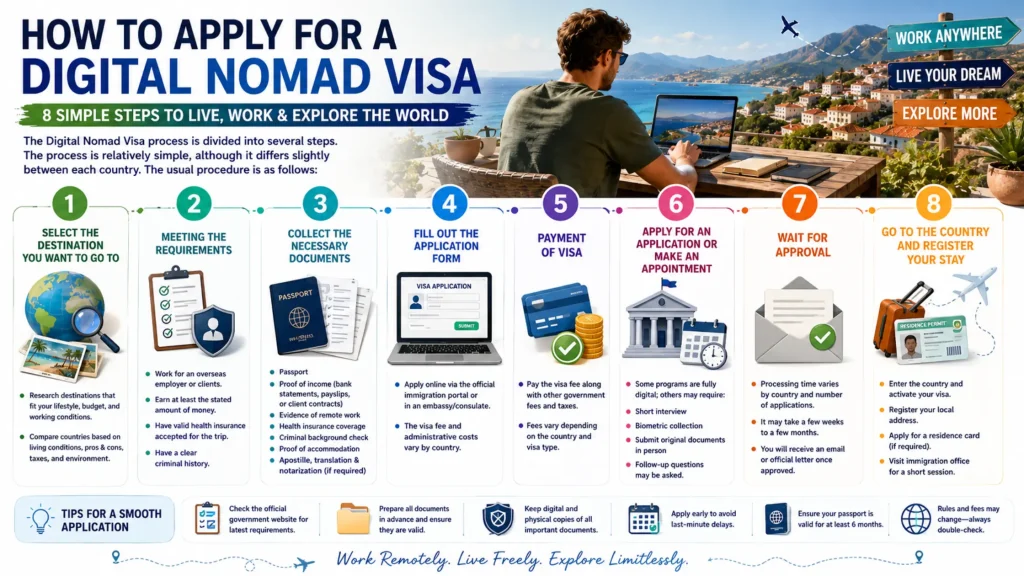
1. Select the destination you want to go to
Start with thoroughly researching about the destination that you want to go to, which fits your lifestyle, budget, and working conditions. Make sure to compare the countries, since each one of them differs from each other in terms of living conditions, pros and cons, taxes, and environment.
2. Meeting the requirements
Please review eligibility criteria before proceeding ahead:
- Work for an overseas employer or overseas clients from abroad
- Earn at least the stated amount of money
- Ensure that you have insurance that is accepted for the trip
- Have a clear criminal history
3. Collect the necessary documents
Gather supporting documents:
- Passport
- Bank statements, payslips, or client contracts as proof of income
- Evidence of distance learning
- Health insurance coverage
- Criminal background check
- Proof of accommodation
- Apostille, translation, and notarization may be required in some countries
4. Fill out the application form
There are a number of countries that offer digital nomad visas that you can apply for:
- Online, via the appropriate government immigration portal
- On the spot in an embassy or consulate
- To pay the visa fee:
- The fees that one has to pay on the visa are variable from country to country, where some administrative costs are lower than others and government processing fees are higher
5. Payment of Visa
Proceed with the visa fees, which may vary depending on country, and other government fees and taxes.
6. Apply for an Application or make an appointment
Some programs are completely digital; 1 or more programs demand the following:
- A short interview.
- Biometric collection.
- Original documents to be submitted in person.
- Follow-up questions about missing items may be sent as well.
7. Wait for Approval
The processing time varies by country and number of applications, generally from a few weeks to a few months. Upon approval of your visa, you will likely get an email or official letter.
8. Go in the country and register your stay
Once your visa is approved, you will be able to visit the country and make your visa effective. For some places you will need to:
- Registering a local address.
- Submit application for residence card.
- See immigration officials in a brief session.
Read Also: – Flying While Pregnant
Conclusion
When you have the option to work remotely, however, you do not like the surroundings because of which you are losing your concentration on work. In this case, you have an option to switch to a new country and that’s when a digital nomad visa helps like a magician. In this guide above, the top 10 countries have been picked for the best digital nomad visa. This will help you to select what’s best for you; every country has its own special factors. So by reading this guide, make up your mind to travel to a different country and start manifesting about yourself sitting on a sofa, having an apartment with a beach view, and writing a report for your manager.
FAQs
More than 60 countries worldwide have official digital nomad visas or extended-stay remote work permits. Usually they permit you to live and work remotely for 6 months to 5 years, as long as you meet certain minimum income requirements and pass background and health checks.
Nope, 30 is definitely not too old to be a digital nomad. The average digital nomad is 32-40 years old, with 50% of the community being 30+ years old.
These visas are made for the people who work from anywhere, basically freelancers, remote workers, and entrepreneurs. The age bar for this visa should be 18 and above; the person should meet the eligibility criteria. And they will need health insurance, no criminal record, and a passport, which should be valid.
Wherever you are in the world, you still have to file US taxes every year, reporting your worldwide income. Because US tax law is based on citizenship, not residency alone. Even if you didn’t spend the whole year on US soil, you still have to file a federal tax return and you might owe US taxes.
The cheapest countries are Vietnam and Indonesia. People who work remotely can live there comfortably. They also get access to fast internet and amenities at a lower cost, making it worth the living for the remote workers.
Read More: –